#0
UV Filter. Absorbs the ultraviolet rays which often makes outdoor
photographs hazy and indistinct. A multi-pupose fine-weather filter for color
as well as black and white films.
#1
UV Filter. Absorbs UV less than 360nm.
#1A (KR 1.5)
UV Skylight Filter. Reduces bluish casts in open shade and filters out
excessive green from shaded foliage.
The filter factor is approximately 1.1.
#1B
UV Skylight Filter. Cuts blue cast in shade and distance, absorbs UV.
#2A
UV Filter. Absorbs UV less than 405nm.
#2B (415)
Absobs ultraviolet radiation under clear sky conditions, reducing blusih
casts with reversal film and haze with black & white. Absorbs UV less than
390nm.
No exposure compensation is required.
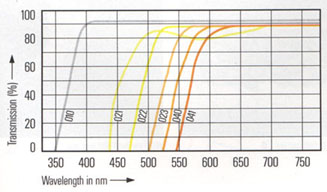
#2C (UV 010)
UV Filter. Improves color rendition and eliminates unsharpness caused by
ultraviolet radiation. The filter reduces distance haze.
No exposure compensation is required.
#2E (021,
420)
Light yellow filter accentuates warm, soft, delicate scenes through the
enhancement of yellow, orange, and red. It is especially suitable for
portraits of women and children, skin tones in natural light, springtime
landscapes, and nature scenes. Produces a better separation of green tones,
and at long distances reduces haze. Absorbs UV.
The filter factor is approximately 1.2.
#3 (Schott CG 455)
Light Yellow Filter. Removes some excess blue in aerial photos. Especially
recommended for landscapes when the sun is positioned low.
The filter factor is approximately 1.2.
#6, K1,
(Schott CG 475)
Yellow filters moderately darken blue sky and shadows illuminated by
blue skylight, and lighten foliage.
#8, K2
(022, Schott CG 495)
The #8 filter is frequently considered a correction filter
which gives approximately "normal" visual rendering of daylight-illuminated
colors with panchromatic films. This medium yellow filter creates subtle
differences between green tones and enhances the natural rendition of the
sky. It is recommended for landscape and foliage photography. It tones down
skin blemishes and ruddiness in daylight portraits, and results in soft skin
tones as well as intensified blonde hair.
Absorbs part of the spectrum between ultraviolet and violet. Makes clouds
stand out. Also used for natural rendition of colors in black and white tones.
The filter factor is approximately 2.
#9 (023,
Schott OG 515)
Deep yellow. More dramatic effect than the #8
filter, further increasing the effects described for the
#8 (022) filter. Contrast increases, clouds
appear more pronounced, haze is deminished and distance vision is improved.
This dark yellow filter distinctly improves reproductions of fine structures
such as sand or snow, and increases contrast on foliage. It diminishes skin
blemishes and freckles in artificial light. It also darkens eye colors and
lightens lip colors.
The filter factor is approximately 3.
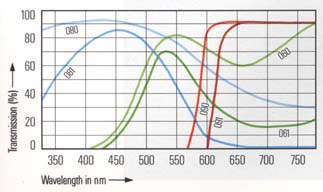
#11, X1
(060)
A light yellow-green filter which corrects panchromatic film to tungsten eye
response. Differentiates green tonal values in landscapes and reduces distant
haze.
The filter factor is approximately 2.
#12
(099, Schott OG 530)
A yellow filter with correspondingly greater effect than the
#6 and #8. The #12 filter is
"minus-blue," meaning it absorbs virtually all light of blue wavelengths.
#13, X2
(061)
A yellow-green filter is similar to the #11 filter,
but stronger. Yellow green filters darken blue sky values and shadows, as well
as red subjects, and lighten foliage somewhat (green filters in general may
have less effect on foliage than expected, partly because of the reduced
sensitivity of panchromatic films to green.) The #13 filter applies a
strong "correction" to panchromatic film under tungsten illumination. A green
filter is recommened when using Kodak Tech Pan to photograph scenes which
contain foliage.
The filter factor is approximately 3.
#15, G
The #15 deep yellow filter filter absorbs some green light as well as all
blue. Used for contrast control in aerial IR photography.
Absorbs part of the spectrum between ultraviolet and bluegreen. Provides
stronger contrast than #8, K2,
and 022)
#16 (040,
Schott CG 550)
Yellow-orange filter darkens blue and violet as well as green and
yellow-green. It is indispensable for all landscape and architectural
photography which require vivid and clear contours. The sky is distinctly
toned with the clouds clearly contrasted against it. This filter is popular
for nude photography under natural light.
The filter factor is approximately 4.
#18A
Yellow-orange. Transmits UV and IR only.
#21
Orange. Contrast filter used for blue and blue-green absorption.
#22
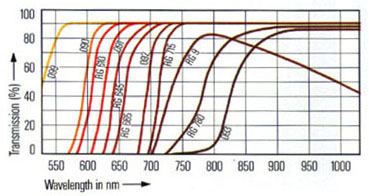
(041, Schott OG 570)
Red-orange filter creates a strong darkening of the sky, dramatic
storm-like cloud reproduction, and strongly enhanced shadows due to its
enhanced contrast. It also achieves good tonal differentiations in
still-life photography by brightening yellow, orange, and red. Not suited for
portrait photography.
The filter factor is approx. 4.
#23A
Red filters tend to darken blue sky and sky-illuminated shadows
considerably and produce strong contrast effects; they also darken diffuse
reflection from foliage. The #23A is red-orange, but has about the same
effect on landscape subjects as the red tricolor #25.
Supresses purple, blue and green.
The filter factor is approx. 4.
#24
(090, Schott RG 595)
Red filters tend to darken blue sky and sky-illuminated shadows
considerably and produce strong contrast effects; they also darken diffuse
reflection from foliage. The #24 (090) is a red tricolor filter that has about
the same effect on landscape subjects as the red-orange
#23A.
The filter factor is approx. 5.
#25
Red filters tend to darken blue sky and sky-illuminated shadows
considerably and produce strong contrast effects; they also darken diffuse
reflection from foliage. The #25 is a red tricolor filter that has about the
same effect on landscape subjects as the red-orange
#23A. Used with #47B and
#58 for color seperation work.
The filter factor is approx. 5.
25A
Absorbs the spectrum between ultraviolet and yellow. Provides the strongest
contrast. Makes daylight scenes appear as though photographed at night. Also
used for infrared photography.
#26
Red. For 3-D anaglyph viewing with a #58 green
filter.
#29
(091, Schott RG 625)
Red filters tend to darken blue sky and sky-illuminated shadows
considerably and produce strong contrast effects; they also darken diffuse
reflection from foliage. The #29 (deep, sharp-cutting tricolor red gives
maximum contrast with landscape and other situations. Used for color separation
and tricolor printing work. Tricolor projection (tungsten) with
#47 (blue) and #61 (green).
The filter factor is approx. 8.
#30
Magenta. Green absorbtion.
#31
Magenta. Green absorbtion.
#32
Magenta. Minus-green (#12 is minus-blue,
#44A is minus-red).
#33
Magenta. Strong green absorbtion.
#34A
Violet. For minus-green and plus-blue seperation in fluorescence processing.
#35
Light blue-green. Contrast in microscopy.
#36
Dark violet.
#38B
Blue. Absorbs red, some UV and green light.
#39
Blue. Contrast control in printing motion pictures.
#40
Green. Two-color photography.
#44
Light blue-green. Minus-red filter with much UV absorbtion.
#44A
Minus-red (#12 is minus-blue,
#32 is minus-green). This filter, used with
a panchromatic emulsion, simulates the effect of an orthochromatic film,
emphasizing blue and green.
#45
Blue. Contrast in microscopy.
#46
Blue. Projection.
#47
A Blue filter (tricolor) that lightens the sky and darkens green foliage
and reds. The use of a blue filter exaggerates atmospheric effects. Used with
#29 and 061 for color
seperation work.
#47A
Light blue. Used for exciting flouresent dye in medical applications.
#47B
Deep blue tricolor. Used for color seperation and tricolor printing.
Used with #25 and #58 for
color seperation work.
#48
Blue. Green and red absorbtion.
#48A
Blue. Green and red absorbtion.
#49
Dark blue.
#50
Very dark blue. Mercury violet.
#52
Light green.
#53
Medium green.
#54
Very dark green.
#55
Green. For 3-D anaglyph viewing with a #25 red filter.
#56
Very light green.
#57
Green. For two-color photography
#57A
Light green.
#58
A strong tricolor green filter that darkens blue sky values and shadows, as
well as red subjects, and lightens foliage somewhat (green filters in general
may have less effect on foliage than expected, partly because of the reduced
sensitivity of panchromatic films to green.) A green filter is recommened when
using Kodak Tech Pan to photograph scenes which contain foliage.
Used with #25 and #47B for
color seperation work.
#59
Green. For tri-color projection.
#59
Very light green.
#60
Green. For tungsten two-color photography.
#61
Deep Green Tricolor. For color separation and tricolor printing. For
tricolor projection with #29 and
#47.
#64
Green. Red absorbtion.
#65
Green. Red absorbtion
#66
Green. For contrast effects in microscopy & medical photography.
#67A
Green. For red absorbtion, two-color projection.
#70 (Schott RG 665)
Red. IR photography, 676 nm.
#72B
Dark orange-yelllow. 605 nm.
#73
Dark yelllow-green. 575 nm.
#74
Dark green. Mercury green. 539 nm.
#75
Dark blue-green. 488 nm.
#76
Dark violet. Compound filter. 449 nm.
#77
Dark violet. Transmits 546 nm mercury line. Glass plus gelatin. 580 nm.
#77A
Dark violet. Transmits 546 nm mercury line. Glass plus gelatin. 582 nm.
#78
Bluish. Photometric filter (visual).
#78AA
Bluish. Photometric filter (visual).
#78A
Bluish. Photometric filter (visual).
#78B
Bluish. Photometric filter (visual).
#78C
Bluish. Photometric filter (visual).
#79
Photographic sensistometry.
#80A (KB 15)
This filter makes possible the use of Daylight film in artificial light
with a color temperature of about 3000°K without the color overtones.
The filter factor is approx. 2.2.
#80B (KB 12)
This dark blue filter acts as a color conversion filter by converting
artificial light of color temperature 3400°K to daylight color film.
Without it, strong yellow-orange color tones would occur.
The filter factor is approx. 2.
#80C
This filter makes possible the use of Daylight film in artificial light
with a color temperature of about 3800°K (clear flash bulbs) without
the color overtones.
#81
Amber. Light balancing filter. Warming -100k.
#81A
Amber. Light balancing filter. Allows Type B daylight color films to be used
with 3400°K photo lamps. Warming -200k.
#81B
Amber. Light balancing filter. Eliminates strong blue cast when buildings, trees,
etc. are photographed in daylight. Warming -300k.
#81C (KR 3)
Amber. Light balancing filter. Prevents blue cast in cloudy and rainy weather.
Especially recommended under cloudless skies. Mountains, seaside or midday sun
calls for the use of a #81C (KR 3), since it reduces undesirable bluish casts.
Kodachrome Type A with flash. Warming -400k.
The filter factor is approximately 1.2.
#81D
Amber. Light balancing filter. Allows Kadachrome Type A color films to be used
with flash. Warming -500k.
#81EF
Amber. Light balancing filter. Allows Kadachrome Type B color films to be used
with flash. Warming -650k.
#82A (KB 1.5)
Light balancing filter. Allows Type B daylight color films to be used with
3200°K photo lamps. The light blue coloration of the #82A (KB 1.5) filter
reduces red casts that can occur when the sun stands close to the horizon. The
#82A (KB 1.5) is therefor a counterpart to #85B
(KR 1.5). The #82A (KB 1.5) is also useful should
you find the color rendition of slide film too warm.
The filter factor is approximately 1.1.
#82B
Light balancing filter. Type B tungsten (artificial) color films can be
used with 2900°K illumination.
#82C (KB 3)
Light balancing filter. Used to convert 5500°K lighting to 3800°K.
The filter factor is approximately 1.2.
#83
Amber. Allows use of 16mm commercial Kodachrome in daylight.
#85 (KR 12)
Light balancing filter. Type A tungsten (artifical light) color films can
be used in daylight or with an electronic flash. The filter is brown and
eliminates the overall blue cast.
The filter factor is approximately 2.
#85B (KR 15)
Light balancing filter. Type B tungsten (artifical light) color films can
be used in conitions such as mountains where even daylight film would require
a KR 3 or a #6 filter.
The filter factor is approximately 2.3.
#85C
Amber. Converts 5500K (daylight) to 3800K lighting.
KB 20
Depending on the percentage of red, conventional household bulbs require
extreme color temperature conversion whenever daylight color film is being used
indoors.
The filter factor is approximately 2.7.
FL-Day (499)
Eliminates green cast when daylight type films are used under daylight type
flourescent lights.
The filter factor is approximately 2.
FL-W
Eliminates green cast when daylight type films are used under white
flourescent lights.
X0
Transmits green and absorbs part of the spectrum between ultraviolet and
blue. Natural rendition of skin and lips of female models. Highly effective
for outdoor portraits.
#87 (Schott RG 780)
Visibly Opaque infrared filter. Transmits IR light greater than 770 nm.
#87A, RM90
(094, Schott RG 1000)
This black infrared filter will filter out the entire visable spectrum.
It is useful with black and white infrared films with a sensitivity from
1000 to 1200 nm.
The filter factor is determined by the film sensitivity.
#87C (093,
Schott RG 830)
This visibly opaque infrared filter will filter out the entire visable
spectrum. It is useful with black and white infrared films with a sensitivity
up to 1000 nm. Transmits IR light greater than 830 nm.
The filter factor is determined by the film sensitivity.
#88A
This infrared filter transmits IR light greater than 770 nm.
#89B, R72
(092, Schott RG 695)
Visibly Opaque used for infrared photography, especially aerial. Transmits
wavelengths greater than 700 nm. This Dark red filter is for black and white
infrared film and filters out light below approximately 650 nm. It allows
pictures of a pure read image while making good use of relatively low
sensitivity of infrared films.
The filter factor is approximately 20-40.
#90,
Dark grayish amber. Monochrome viewing filter. Visually approximates the
relative tones of gray produced in black-and-white prints by different colors
under daylight illumination. 10% luminous transmittance.
#96
Dark grayish amber. Neutral filter for controlling luminance. 9% luminous
transmittance.
#97
This filter is used for dichroic absorption.
#98
Blue. Equivalent to #47B
plus #2B.
#99
Green. Equivalent to 61 plus
#16.
#102
Yellow-green. Converts barrier-layer photocell response to eye luminosity
response.
#106
Amber. Converts an S-4 type photocell response to eye luminosity
response.
ND-1 (101)
This light tinted filter reduces light transmission when there is too much
light while using high-speed film.
The filter factor is 2.
ND-2 (102)
By using this filter, it is possible to use the relatively longer shutter
speeds while retaining a wide aperture even in bright illumination. This allows
for the emphasis of the subject by controlling depth of field or creating
motion effect with subject blur.
The filter factor is 4.
ND-3 (103)
This filter is denser than 102 and more light absorbing. It is suited for
video, especially when a small enough lens opening is not available. In
addition, a specific depth of field limit can be obtained.
The filter factor is 8.
ND-6 (106)
This filter is especially useful when making extremely long exposures
(several minutes). It is also suited for video.
The filter factor is 64.
ND-10 (110)
This filter is useful for the observation and documentation of industrial
processes at high temperatures and light levels. This type of filter prevents
strong flare and brings out interesting details.
the filter factor is 1000.
ND-13 (113)
This filter belongs in the realm of industrial processes and lunar
astrophotography. Due to its high density, it allows for the long exposures
which are necessary.
The filter factor is 10,000.
ND-20 (120)
This filter is especially made for observation and photography of the sun.
Be cautioned, however, that direct observation of the sun through any filter is
to be strictly avoided since long wavelength infrared radiation, which is
harmful to the eye, is not blocked.
The filter factor is 1,000,000.
484
Violet. This deep violet filter transmits only ultraviolet light almost
without reduction. It is used in flourescent photography in front of the light
source. In addition, it can be used for black-and-white photography for the
enhancement of haze and fog.
The filter factor is approximately 10.
REFERENCE
Kodak Technical Data/Reference, Kodak Filters, No. B-3AKIC.